Spatterdock / Yellow Water Lily
Spatterdock is a rooted plant with floating leaves supported by a stem. The leaves are heart-shaped and grow 4 to 10 inches wide. The leaves have a notch wide rounded lobes and are green on both upper surface and underside. The flowers are one to two inches wide and protected by rounded yellow sepals.

INVASIVE AQUATIC VEGITATION AND HOW TO IDENTIFY THEM
White Water Lily
White Water Lily is a rooted plant with floating leaves supported by a stem. The leaves are round and grow 4 to 12 inches in diameter. The leaves have a narrow notch, are green on the upper surface, and the underside is usually red to purple. The flowers are white to magenta and very fragrant. The flowers are 2 to 8 inches in diameter and close during the night and reopen each morning. These plants provide essential habitat to many aquatic organisms and are great attractors of pollinators.

Duckweed
Duckweed is a very small floating plant with hair like roots that hang down into the water. A single plant can have a group of two to five leaves. The leaves are about three millimeters in diameter and are usually nearly flat.

Watermeal
Watermeal is a tiny free-floating plant without roots of any type. These plants float on or just below the water surface. They are singular, oval-shaped leaves with a slightly rounded surface. The largest watermeal plants measure only one millimeter long, slightly larger than a grain of sand.

Blue-Green Algae
Cyanobacteria "Blue-Green Algae" are unicellular organisms that use phycocyanin to perform photosynthesis and are usually
blue-green in color. They can form large blooms in the water that look like teal paint in the water. Some species of Cyanobacteria can produce toxins that are harmful to other wildlife, pets, and humans.

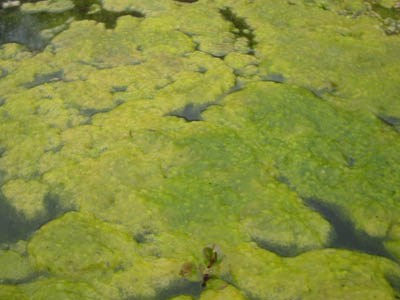
Green Algae
Green algae are unicellular organisms that use chlorophyll to perform photosynthesis and appear green. These organisms can look like green paint in the water, scum, or filaments. Although they are unicellular, green algae can form thick, dense mats on the surface of your waterbody. They are the primary producers in the water and are necessary for a healthy ecosystem, but can quickly grow to nuisance levels.